The past is a slippery thing. When we try to pry our favorite memories from it, they always seem to slip just outside our grasp. Surely, Uni students know well the pain of sitting in a room on finals day and watching as the material completely fades away before your eyes, leaving you without a clue how to do problem two. Yet, often, the things that we most wish to stow away forever never leave us alone; an embarrassing accident, a bad performance, a stupid rumor. They haunt us, sometimes hiding away but always in order to redouble the next grievance. In much the same way, the past in Beloved is shown to haunt Sethe and the other characters both metaphorically (Sethe's painful memories of Sweet Home) and literally (the dead baby ghost in 124). Moreover, each character seems to represent a different way to deal with this atrocious spectre of the past that looms over their heads.
The kids have a very different place coping with their past than the adults. For one thing, the only nightmare they have to relive is the shed episode. But, their methods of making everything okay do not show them to be as strong as their elders. They never make any direct references to the event themselves; Howard and Buglar haven't even been shown to speak, let alone talk to each other about the incident: "Say, Buglar, do you remember when dear old mum nearly killed us all?" Denver was far too young to remember anything. And, even assuming that Beloved really is the crawling-already?baby, she hasn't spoken about the fateful day at all herself. However, their reactions are much more cut-and-dry. Howard and Buglar can't even put up with the ghost, and they simply run away, hoping to leave the past behind. Denver seems to suffer the most from these trials. She becomes a recluse in the house, without friends at school or in the neighborhood. She tries to make up for it by running off to her "room" of boxwood bushes, playact as if her life is normal enough. Her idea of coping is still to run off, but now she's only running inside herself.
The adults have a much more mental reaction to their past rather than the physical response of the children. Baby Suggs, who had gotten over the destitution of slavery by the intoxication of freedom, along with a dash of hope that her son might join her eventually, broke down after the shed episode. She shut out the world; perhaps her hip was in too much pain to straight run away. She retreats to her bed, and shuts out everything of the outside world that might do harm; nothing matters but her colors. She became obsessed with the one thing that wouldn't do anybody harm, trying to block out any memories of the appalling act that occurred in her shed. Sethe is not much better herself. She engages in a thick doublethink, recalling fondly parts of Sweet Home while trying desperately to shove away the rest of it. Moreover, she defends her actions in the shed, pushing away the idea that anything else could have worked, could have kept her babies safe from schoolteacher. It's this precise doublethink that alienates her from the rest of the community; it's one thing to say that her actions were successful despite the consequences, but another thing entirely to say that what she did was the right choice. Killing her daughter may have worked, and it may have been the only way, but nobody else will accept her back until they see that she is sorry for the taking of life not too dissimilar to what schoolteacher himself had intended to do. And so, as we are beginning to see in part two, she is walling herself off just like Baby Suggs did before.
Paul D is an interesting case. He has shown himself to have gone through hell and back and yet he's readjusted himself to be as normal as possible. He removed the wild from his eye after having the bit. He survived the prison in Alfred, Georgia, and has shown himself to bounce right back now that he's been out for a while. Surely, he should be the best able to cope with the news of what happened twenty-eight days after Sethe arrived at 124. However, he, in entirely the same way the rest of the community already has, shuns the sinners. He doesn't fully run away; although he is trying to escape the reach of Beloved (his *click* comes after hearing Sethe's story, when he thinks to himself, "That bitch is looking at me; she is right over my head looking down through the floor at me" (193-194). But, he doesn't do the same thing as Howard and Buglar; instead of leaving and, like Lot, refusing to look back upon the great mound of sin he left behind, he spends a few nights in the basement of the church in order to clear his head and think things through. He has so far been the one to pull the ladies of 124 back in the direction of normal (getting them to go to the carnival), and I wouldn't be surprised if he bounces back again to continue his work.
Throughout the story, Toni Morrison focuses not just on the facts of the events that occur but on the reactions of the characters to them, and this is an important point to add onto the raw data. They show us how we should respond to stress (like how Paul D has accepted the past and can talk about it without bringing himself to severe pain) and how we shouldn't (such as how Sethe bites Paul D's head off when he fills in the gaps on where Halle was when the escape went awry). The story is a cautionary tale as much as a tragedy; leaving tensions unresolved is the way to get yourself into trouble, sure as anything else.
Thursday, December 13, 2012

Sunday, December 9, 2012
Death and All Its Trappings
In real life, death is an unattractive thing. Suicides are mercifully rare; very few people get to points in their life where oblivion seems like a more positive state than continuing in life. Even those who believe in some sort of afterlife don't go rushing into it. For most people, there is some unfinished business on earth that needs to be resolved. Who's ready for death?
So, if death is such a negative in real life, why would it be portrayed so positively in "Go Down Death (A Funeral Sermon)" by James Weldon Johnson? I mean, who wouldn't want to take home this cutie?
This wonderful stallion is forever raring up outside Denver Airport. And if you think it's just the lighting...
This guy's pretty freaky all the time. Admittedly, he's not white, but a horse befitting death would more appropriately look like this than any one of these:
Do these horses look "Pale as a sheet in the moonlight" to you? Which of these would you be more likely to guess lacks blood running through its (very visible, I can assure you) veins?
So, perhaps Death's glorious steed isn't so beautiful as at first glance. But is not Death himself heroic? For one thing, God himself sent him to collect Sister Caroline (an interesting departure from normal Christian tales, in which Sister Caroline would've been straight away visited by Jesus -- how hard could it be for a deity that knows everybody and can be everywhere to meet one measly soul for its journey to heaven?). We can tell from his first direct appearance when he's in "that shadowy place, / Where Death waits with his pale, white horses." Nothing creepy about that...
Or how about his mysterious loner side? You know, how "the hooves of his horses struck fire from the gold, / But they didn't make no sound"? Or how about how "Death didn't say a word" in response to God's command to go get Sister Caroline? Only really cool, suave guys, like Edward Cullen, teen heartthrob, would do something like that. He rides through a storm, as the poem says "On Death rode, / Leaving the lightning's flash behind." Nothing ominous about storms. He holds Sister Caroline "in his icy arms," as would be the nicest, most comforting thing to hold somebody with. The point is, this guy is not the next McSteamy. Young ladies will not swoon for his beauty. He isn't carrying Sister Caroline to heaven like some vaguely sinister Fabio.
However, all this isn't to say that Death is portrayed as a malevolent, incipient harbinger of doom. Everybody knew it was Sister Caroline's time to go. It the reason for God's command in the first place:
But, not only that, he mentions her specific struggles, saying, "She's borne the burden and the heat of the day, / She's labored long in my vineyard." So, Death wasn't stealing her away before her time. And when he appears before Sister Caroline, she calls him Old Death, and the narrator says, "He looked to her like a welcome friend." He's taking her home.
So, who's ready for death? Well, Sister Caroline is, for one. In fact, today, several people probably lie on their deathbed, pleading for the pale, white horses to trod soundlessly their way. Death isn't just for those who are "too young" to die. And that's what this "sermon" is getting to. For all Death's apparent unpleasantness, Sister Caroline is ready for him. Now, everybody else needs to let her go.
So, if death is such a negative in real life, why would it be portrayed so positively in "Go Down Death (A Funeral Sermon)" by James Weldon Johnson? I mean, who wouldn't want to take home this cutie?
 |
| Denver Airport, the center of all things evil |
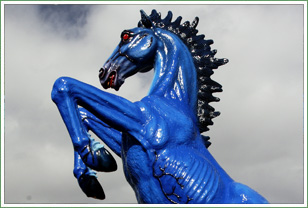 |
| Look at those veins! |
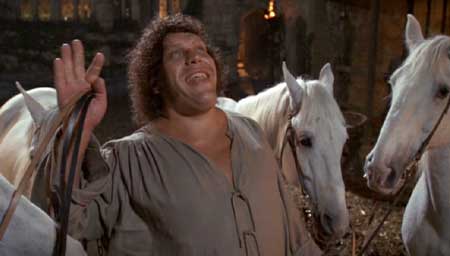 |
| From The Princess Bride. "Hello, Lady!" |
Do these horses look "Pale as a sheet in the moonlight" to you? Which of these would you be more likely to guess lacks blood running through its (very visible, I can assure you) veins?
So, perhaps Death's glorious steed isn't so beautiful as at first glance. But is not Death himself heroic? For one thing, God himself sent him to collect Sister Caroline (an interesting departure from normal Christian tales, in which Sister Caroline would've been straight away visited by Jesus -- how hard could it be for a deity that knows everybody and can be everywhere to meet one measly soul for its journey to heaven?). We can tell from his first direct appearance when he's in "that shadowy place, / Where Death waits with his pale, white horses." Nothing creepy about that...
 |
| You should probably know where this is from... |
However, all this isn't to say that Death is portrayed as a malevolent, incipient harbinger of doom. Everybody knew it was Sister Caroline's time to go. It the reason for God's command in the first place:
And his eye fell on Sister Caroline,
Tossing on her bed of pain.
And God's big heart was touched with pity,
With the everlasting pity.
But, not only that, he mentions her specific struggles, saying, "She's borne the burden and the heat of the day, / She's labored long in my vineyard." So, Death wasn't stealing her away before her time. And when he appears before Sister Caroline, she calls him Old Death, and the narrator says, "He looked to her like a welcome friend." He's taking her home.
So, who's ready for death? Well, Sister Caroline is, for one. In fact, today, several people probably lie on their deathbed, pleading for the pale, white horses to trod soundlessly their way. Death isn't just for those who are "too young" to die. And that's what this "sermon" is getting to. For all Death's apparent unpleasantness, Sister Caroline is ready for him. Now, everybody else needs to let her go.
Thursday, November 15, 2012
Now, This Is a Story All About How My Life Got Flipped Turned Upside-Down
In The White Boy Shuffle, Mrs. Kaufman's decision to move the family from sunny Santa Monica to the hellish Hillside always struck me as odd, but I couldn't quite pin down why. She gives a reasonable enough explanation; the kids are being raised very similarly to Janie in Their Eyes Were Watching God, in which we can see problems arising from African-Americans being raised outside of their culture. Logan says at one point that Janie's refusal to work is a sign of how she was spoiled, and needed to bring herself down from her high chair. Ostensibly, this is what Mrs. Kaufman fears in Gunnar and the girls; she wants them to experience the full meaning of being black in America, and that means moving to the ghetto. But, still it strikes a strange chord, like something wasn't right in moving from the nice neighbourhood to the run-down one. But, I pushed it to the back of my head, thinking that this was merely a show of my naivete, in that everybody should always aspire to be like me and live the way I do.
It was some time later that it finally dawned on me why precisely the move seemed so precisely bizarre. The truth is, Beatty is inverting the somewhat common trope of "the one who made it out," where generally speaking a character leaves a place that others don't particularly want to live in but don't leave for family or lack of money. That is, the character moves out of the ghetto into some nicer place (a more lucrative job, college, suburbia, whatever). Will in The Fresh Prince of Bel-Air is a good example of this; his mom sends him to live with his rich uncle and aunt in a nice California neighbourhood after he gets in a fight with some gangsters in Philadelphia. Another example would be the Freemans in The Boondocks, who move from Chicago to Woodcrest, the epitome of white suburbia. Even Bigger Thomas does this to a degree in Native Son: although he neither moves out of the south side of Chicago nor leave it at all, he still takes a job in affluent Hyde Park as a chauffeur rather than something "on the wrong side of the tracks," presumably like his old job as a commercial driver.
So, why specifically is Gunnar going against the grain here? What is Beatty trying to say by thrusting Gunnar the opposite direction of how this is "supposed to go"? In a sense, it almost seems like he's condemning those who leave the ghetto for bigger and better places. Gunnar is the model of success within his new home; despite a rough start, he eventually makes friends with Scoby, becomes a great poet, and discovers his basketball ability. He wouldn't have done any of these things in Santa Monica; in fact, nothing about his younger years there contribute positively to these occurrences. He earns the respect of Scoby by loudly throwing away the traditionally "right" thing to do (deliver his monologue perfectly) and by embracing his new home (interspersing his new speech with phrases indigenous to Hillside). He begins to think about poetry right after this, and largely as a consequence of this -- his invented monologue is very much a vision of what's to come in his poems. Moreover, the informational background that Gunnar has for his poems isn't something he learned in any school; he's shown to be very auto-didactic, reading old classics in his tent in the department store. And his basketball ability seems to be raw talent; he'd never even played before Hillside, only learning the rules. Back in Santa Monica, he didn't really have anything comparable to his successes in Hillside; he had friends, but they weren't like Scoby. None of them were black, and Gunnar at some points keeps his interests in people like the Tuskegee airmen hidden because it wouldn't seem as cool as the fact that Hitler was missing a testicle. His actions amounted to mere hooliganry in Santa Monica, while Hillside at least had seriously positive moments. Beatty later more conclusively points out how unwelcome black people seem to be in the nicer neighbourhoods with the Harvard recruiter, who claims Hillside and its residents (not realizing Gunnar lives there) to be irredeemable in its awfulness. The white crowds boo Scoby and Gunnar during their games playing for Boston University, while "all of Harlem" comes to see them and cheer them on against Columbia. It certainly fits with the theme of the novel, that these were times so difficult and heavy for African-Americans that they were better off killing themselves than going on trying to live. This strengthening of the idea in the novel that black people who leave their assigned place are doomed to suffer the consequences certainly bodes badly for general race relations. And, the inversion of a common trope brings the reader's attention to this issue subconsciously, such that you hardly notice its very real effect.
It was some time later that it finally dawned on me why precisely the move seemed so precisely bizarre. The truth is, Beatty is inverting the somewhat common trope of "the one who made it out," where generally speaking a character leaves a place that others don't particularly want to live in but don't leave for family or lack of money. That is, the character moves out of the ghetto into some nicer place (a more lucrative job, college, suburbia, whatever). Will in The Fresh Prince of Bel-Air is a good example of this; his mom sends him to live with his rich uncle and aunt in a nice California neighbourhood after he gets in a fight with some gangsters in Philadelphia. Another example would be the Freemans in The Boondocks, who move from Chicago to Woodcrest, the epitome of white suburbia. Even Bigger Thomas does this to a degree in Native Son: although he neither moves out of the south side of Chicago nor leave it at all, he still takes a job in affluent Hyde Park as a chauffeur rather than something "on the wrong side of the tracks," presumably like his old job as a commercial driver.
So, why specifically is Gunnar going against the grain here? What is Beatty trying to say by thrusting Gunnar the opposite direction of how this is "supposed to go"? In a sense, it almost seems like he's condemning those who leave the ghetto for bigger and better places. Gunnar is the model of success within his new home; despite a rough start, he eventually makes friends with Scoby, becomes a great poet, and discovers his basketball ability. He wouldn't have done any of these things in Santa Monica; in fact, nothing about his younger years there contribute positively to these occurrences. He earns the respect of Scoby by loudly throwing away the traditionally "right" thing to do (deliver his monologue perfectly) and by embracing his new home (interspersing his new speech with phrases indigenous to Hillside). He begins to think about poetry right after this, and largely as a consequence of this -- his invented monologue is very much a vision of what's to come in his poems. Moreover, the informational background that Gunnar has for his poems isn't something he learned in any school; he's shown to be very auto-didactic, reading old classics in his tent in the department store. And his basketball ability seems to be raw talent; he'd never even played before Hillside, only learning the rules. Back in Santa Monica, he didn't really have anything comparable to his successes in Hillside; he had friends, but they weren't like Scoby. None of them were black, and Gunnar at some points keeps his interests in people like the Tuskegee airmen hidden because it wouldn't seem as cool as the fact that Hitler was missing a testicle. His actions amounted to mere hooliganry in Santa Monica, while Hillside at least had seriously positive moments. Beatty later more conclusively points out how unwelcome black people seem to be in the nicer neighbourhoods with the Harvard recruiter, who claims Hillside and its residents (not realizing Gunnar lives there) to be irredeemable in its awfulness. The white crowds boo Scoby and Gunnar during their games playing for Boston University, while "all of Harlem" comes to see them and cheer them on against Columbia. It certainly fits with the theme of the novel, that these were times so difficult and heavy for African-Americans that they were better off killing themselves than going on trying to live. This strengthening of the idea in the novel that black people who leave their assigned place are doomed to suffer the consequences certainly bodes badly for general race relations. And, the inversion of a common trope brings the reader's attention to this issue subconsciously, such that you hardly notice its very real effect.
Tuesday, November 13, 2012
The Murder of Nicholas Scoby
Gunnar Kaufman is either the most naive person on the planet Earth or the worst friend there. Let me explain. All of the hints were there. Scoby nearly tells him outright what he plans to do. But Gunnar, the fool that he is, doesn't seem to get the fact that Scoby is about to kill himself. Scoby calls himself the forty-eighth ronin and makes several references to suicide. He asks Gunnar if he's serious about riling everybody up to off themselves. He explicitly asks whether or not you need a permit to kill yourself (notwithstanding the obvious difficulties of enforcing such a permit). He even tells Gunnar where he plans to jump by asking where the tallest building around is. So why doesn't Gunnar do anything?
Gunnar elsewhere says about the people who are killing themselves in his honor, "But I don't feel responsible for anything anyone else does. I have enough trouble being responsible for myself" (201). Certainly, he's not putting the gun into anybody's hand; he's not holding their family hostage to force them to kill themselves. But, to say that he is not responsible at all is ridiculous. The man is actively inciting others to commit suicide; he dares them to write poems before they go to be more memorable. Innocence here would be to say nothing. Innocence here would under no condition be to triple dog dare everybody to stab themselves and sign his name in their blood with the poem.
But why doesn't Gunnar even think about saving Scoby? It's not like he's willing himself to die; despite talk about taking away the satisfaction of killing him from the government or whoever, he doesn't commit suicide but instead challenges them directly to come and kill him, going against what he explicitly tells Psycho Loco he won't do: "So it's useless for an enemy to challenge you, right? ... Might as well kill myself, right? Why give you the satisfaction" (226). His only reaction after Scoby's talk about suicide and even his actual death is to take notes for a poem and to wonder what noise his body made as it hit the pavement. All Scoby can rouse out of Gunnar is unhappiness that there wasn't a glory to accompany Gunnar's pitiful Brocken specter as he sat at the top of the law building.
The truth is, Gunnar is a huge chicken. He's letting everyone down by not even killing himself, just going through the motions of life. Depression is a funny thing; it's not entirely household knowledge, but antidepressants unexpectedly raise a patient's rate of suicide. This may seem absurd, but the reason is surprisingly simple: those who are depressed don't always even have the emotional strength to consider offing themselves. The drugs make things just good enough that this option returns to the table. It's certainly possible that Gunnar is now very seriously depressed. He doesn't like playing basketball anymore, dismissing the idea that his "purpose in life is to make these free throws, then run back and play defense" (190). At his South Africa speech, he says, "Matter of fact, I ain't ready to die for anything, so I guess I'm just not fit to live. In other words, I'm just ready to die. I'm just ready to die" (200).
Yet even though he goes to such length to describe how he wants to die, there's no sign he's actively trying to kill himself. For an unafflicted reader, depression isn't a compelling enough reason to feel sympathy when the patient is still encouraging others to do the thing he can't. Refusing to talk to Scoby seriously when he most needed it doomed him to death. But, Gunnar still comes out alive, and that's more than he seems to deserve by the end of the novel.
Gunnar elsewhere says about the people who are killing themselves in his honor, "But I don't feel responsible for anything anyone else does. I have enough trouble being responsible for myself" (201). Certainly, he's not putting the gun into anybody's hand; he's not holding their family hostage to force them to kill themselves. But, to say that he is not responsible at all is ridiculous. The man is actively inciting others to commit suicide; he dares them to write poems before they go to be more memorable. Innocence here would be to say nothing. Innocence here would under no condition be to triple dog dare everybody to stab themselves and sign his name in their blood with the poem.
But why doesn't Gunnar even think about saving Scoby? It's not like he's willing himself to die; despite talk about taking away the satisfaction of killing him from the government or whoever, he doesn't commit suicide but instead challenges them directly to come and kill him, going against what he explicitly tells Psycho Loco he won't do: "So it's useless for an enemy to challenge you, right? ... Might as well kill myself, right? Why give you the satisfaction" (226). His only reaction after Scoby's talk about suicide and even his actual death is to take notes for a poem and to wonder what noise his body made as it hit the pavement. All Scoby can rouse out of Gunnar is unhappiness that there wasn't a glory to accompany Gunnar's pitiful Brocken specter as he sat at the top of the law building.
The truth is, Gunnar is a huge chicken. He's letting everyone down by not even killing himself, just going through the motions of life. Depression is a funny thing; it's not entirely household knowledge, but antidepressants unexpectedly raise a patient's rate of suicide. This may seem absurd, but the reason is surprisingly simple: those who are depressed don't always even have the emotional strength to consider offing themselves. The drugs make things just good enough that this option returns to the table. It's certainly possible that Gunnar is now very seriously depressed. He doesn't like playing basketball anymore, dismissing the idea that his "purpose in life is to make these free throws, then run back and play defense" (190). At his South Africa speech, he says, "Matter of fact, I ain't ready to die for anything, so I guess I'm just not fit to live. In other words, I'm just ready to die. I'm just ready to die" (200).
Yet even though he goes to such length to describe how he wants to die, there's no sign he's actively trying to kill himself. For an unafflicted reader, depression isn't a compelling enough reason to feel sympathy when the patient is still encouraging others to do the thing he can't. Refusing to talk to Scoby seriously when he most needed it doomed him to death. But, Gunnar still comes out alive, and that's more than he seems to deserve by the end of the novel.
Monday, November 12, 2012
Robert Freeman Is the Greatest Civil Rights Leader that Never Existed
The Boondocks Intro Theme - Asheru
I am the stone that the builder refused;
I am the visual,
The inspiration,
That made lady sing the blues.
I'm the spark that makes your idea bright,
The same spark
That lights the dark
So that you can know your left from your right.
I am the ballot in your box ,
The bullet in the gun,
The inner glow that lets you know
To call your brother son,
The story that just begun,
The promise of what's to come,
And Imma remain a soldier till the war is won.
I am the visual,
The inspiration,
That made lady sing the blues.
I'm the spark that makes your idea bright,
The same spark
That lights the dark
So that you can know your left from your right.
I am the ballot in your box ,
The bullet in the gun,
The inner glow that lets you know
To call your brother son,
The story that just begun,
The promise of what's to come,
And Imma remain a soldier till the war is won.
It's not hard to see how The Boondocks is in many ways similar to Paul Beatty's The White Boy Shuffle. Both serve as contemporary commentaries on African-American life, from the more general -- Gunnar hated "fried chicken even before I knew I was supposed to like it" (35) while Huey becomes sick from watching too much BET ("Riley Wuz Here") -- to the uncharacteristically specific -- the LA riots for Gunnar and the ballad of Latarian Milton (or, his parody name for the show, Lamilton Taeshawn ["Smokin' with Cigarettes"]). But, the two stories' protagonists have very different responses to the difficulties that still persist for African-Americans today, as can be seen merely from the show's opening theme.
It's not hard to see the builder's refusal (racism) in Gunnar's life. His own father beats him, saying, "You are not a Kaufman. I refuse to let you embarass me" (137). The poetry class at BU can't let him be just a poet: "Well, it's really you. I thought that if I mentioned a black poet, I wouldn't be taken seriously by the rest of the class" (179). And while both Huey and Gunnar aren't exactly the visual of abject poverty that could be conjured (Huey lives in white suburban Woodcrest and Gunnar is the model of success with his poetry books and basketball victories), they still come together to be a spark to action. Their main differences can be defined by this action. Gunnar uses his fame and power to convince black people everywhere to kill themselves in defiance of the white man. Huey, on the other hand, was cut off from African-American society when the Freemans moved from Chicago to suburbia, and his efforts tend to amount to little, like in "The Block is Hot" where he only musters white people who sympathize with his ideals but won't actually do anything to come protest.
Yet, despite Gunnar's obvious advantage in raising forces to do his bidding, as far as aiding African-Americans goes, Huey is a much more compelling character. Unlike Gunnar, he still believes "the promise of what's to come," and fights for it. Gunnar sits around daring the government to kill him. He won't even match the efforts of those he convinces to commit suicide; the government will have to do that job for him. There's no willingness to commit to anything; Gunnar has just become too apathetic to do anything beyond what he immediately needs to in order to keep himself and his family alive to their death by A-bomb. In his defense, he says, "So it's useless for an enemy to challenge you, right? ... Might as well kill myself, right? Why give you the satisfaction" (226). But the problem with that statement is that he very clearly is challenging the government, is giving them the satisfaction because he refuses to actually stand up for what he believes in like he's convinced everyone else to and kill himself. Huey, on the other hand, puts himself on the front lines, calling in weird, random blackmail threats to save unjustly imprisoned black people ("The Passion of Reverend Ruckus"). In fact, the only reason Huey doesn't go to the jail himself to bust the man out is he couldn't get a ride there; he even acknowledges that he would probably die in the process, but says that the cause is worth it. In comparison, Gunnar seems like he's given up even trying to make a statement and won't even commit suicide for fear it would make too big a wave.
Monday, October 22, 2012
A Turn for the Unexpected
Up to this point in Their Eyes Were Watching God, Tea Cake seems like an unusually progressive man. Where Logan's main concern was his farm rather than Janie, and Jody's main concern was status, Tea Cake has always seemed to be very focused on Janie. As a result of these, Logan and Jody were both seen by Janie as restricting her, albeit in different ways, while Tea Cake has allowed her to do much as she pleases. But, for all his progressive stance before, when it comes down to Mrs. Turner's brother, Tea Cake makes a very unusual move. In order to prevent Mrs. Turner and her brother from getting it into their heads that Janie was theirs for the taking, he beats Janie. He doesn't yell at Mr. Turner, or even Mrs. Turner, he just hits his own wife. Where did that come from?
This isn't to say he did it with no reason. It's explained that Mr. Turner is useless, and Tea Cake probably doesn't wield enough influence over Mrs. Turner for that route. In fact, Janie can't even dissuade her, despite the oodles of power she gives Janie. But, at least in the present, beating one's wife over such a matter seems like such an overreaction, or if nothing else a misplacement of anger. Surely this could've been handled differently; at last resort, couldn't Janie and Tea Cake just go around saying he beat her? But, instead, the book is very clear about the realness of the act, saying, "Before the week was over he had whipped Janie. Not because her behavior justified his jealousy, but it relieved that awful fear inside him. Being able to whip her reassured him in possession" (147). For a man with reasonably progressive ideas at the time (letting Janie play checkers and engage in the porch-talk, for example), the fact that he refers to his marriage to Janie as a "possession" severely relegates her role in the relationship. It seems to almost take the wind out of the sails of feminism that Janie had been riding before. Sure, she made the decision for this man who started off very kind to her, but he still ended up similar to Jody in different ways. She's still something that he has control over in his mind, and the fact that Janie doesn't seem to react to this sets off alarm bells in my head. But, perhaps, I am misreading this passage...
This isn't to say he did it with no reason. It's explained that Mr. Turner is useless, and Tea Cake probably doesn't wield enough influence over Mrs. Turner for that route. In fact, Janie can't even dissuade her, despite the oodles of power she gives Janie. But, at least in the present, beating one's wife over such a matter seems like such an overreaction, or if nothing else a misplacement of anger. Surely this could've been handled differently; at last resort, couldn't Janie and Tea Cake just go around saying he beat her? But, instead, the book is very clear about the realness of the act, saying, "Before the week was over he had whipped Janie. Not because her behavior justified his jealousy, but it relieved that awful fear inside him. Being able to whip her reassured him in possession" (147). For a man with reasonably progressive ideas at the time (letting Janie play checkers and engage in the porch-talk, for example), the fact that he refers to his marriage to Janie as a "possession" severely relegates her role in the relationship. It seems to almost take the wind out of the sails of feminism that Janie had been riding before. Sure, she made the decision for this man who started off very kind to her, but he still ended up similar to Jody in different ways. She's still something that he has control over in his mind, and the fact that Janie doesn't seem to react to this sets off alarm bells in my head. But, perhaps, I am misreading this passage...
Mother South and Her Many Children
The South is not easily separable from its past. It is well known for its many racist procedures, from slavery to Jim Crow. Yet, despite its very present past (or, in this case, present), three very different characters with very different ideas about it have come up in our books so far. In Native Son, it is revealed that Bigger actually hails from the South. However, this fact actually doesn't come into play very much. And for such a naturalist book, this seems a bit out of place (Shouldn't his birthplace have had some effect on his development?), but it's non-importance seems to signal a specific stance that Wright takes: the subtle northern racism had just as much, if not more effect on Bigger's personality. Certainly, this is a strange statement, considering that Bigger's childhood years seem to be given the short end of the stick when they have a much larger and longer-lasting influence on his life. Despite this, Wright seems to merely shrug its impact off, and moves on to what he cares about more.
Invisible Man is a little different. It spends a lot more time looking at the South, and it certainly gives it a much larger impression on the narrator, but something still appears off about it. The truth is, the narrator seems to be an outlier for the South, one of very few people who actually get the game. And, once he understands what is going on, he's already in Harlem, nightmares of Dr. Bledsoe and his grandfather long gone. So, in exchange for giving the South more importance, the book shortchanges the black people that live there somewhat, making them not much better off than those from Native Son.
But, after these two books that place a heavy emphasis on the North, we get Their Eyes Were Watching God. Here, we get a rich variety of characters all from the South, and it becomes greater than a simple birthing place for revolutionaries. So, what's wrong with this display of black culture? The problem, at least to those like Wright, is that the past for them is something to be forgotten just as it is for the South today. The South and its people, at least in Hurston's book, show off something that Wright would just as soon leave behind. And Hurston didn't cheat the people in her story; they aren't characters from some minstrel show but real people depicted living the way they live. And while it's understandable to be ashamed of one's past, sometimes its just better to let the bad feelings go, and others will reciprocate.
Invisible Man is a little different. It spends a lot more time looking at the South, and it certainly gives it a much larger impression on the narrator, but something still appears off about it. The truth is, the narrator seems to be an outlier for the South, one of very few people who actually get the game. And, once he understands what is going on, he's already in Harlem, nightmares of Dr. Bledsoe and his grandfather long gone. So, in exchange for giving the South more importance, the book shortchanges the black people that live there somewhat, making them not much better off than those from Native Son.
But, after these two books that place a heavy emphasis on the North, we get Their Eyes Were Watching God. Here, we get a rich variety of characters all from the South, and it becomes greater than a simple birthing place for revolutionaries. So, what's wrong with this display of black culture? The problem, at least to those like Wright, is that the past for them is something to be forgotten just as it is for the South today. The South and its people, at least in Hurston's book, show off something that Wright would just as soon leave behind. And Hurston didn't cheat the people in her story; they aren't characters from some minstrel show but real people depicted living the way they live. And while it's understandable to be ashamed of one's past, sometimes its just better to let the bad feelings go, and others will reciprocate.
Of the Study of Invisibility and Odd Titles
Do you know the name of your garbageman? Or how about the condition of your waiter's love life? In all truth, you probably don't; to you they're just some person who goes about their life without any strong reference to yours. And while some people claim society or technology is to blame for this ("Back in my day I knew everybody in town! You young'uns need to get your face out of your phone and talk to people!"), the truth is far more sinister. Enter the dubiously-titled "Monkeysphere." Also known more scientifically as Dunbar's number, this concept refers to the number of other people a person can maintain stable relationships with. And since it all started with some harmless monkey fun, why don't we start with a monkey illustration?
Say you have a pet monkey. His name is not important, but the basic idea is that you have a good knowledge of your monkey friend. You and he might play together, fight evil together, it's not too important. You'd miss him if he died. But now, you have five monkeys. A little bit tougher, but with some practice you can distinguish each monkey by their little monkey ways. How about one hundred? It gets tougher. But, the point is still the same, more monkeys equals more problems. Eventually, you get to a point where there's simply too many monkeys to handle, and they become a wave of hair and flesh. But instead of being some lofty philosophical ideal, we've discovered experimentally at what point double the monkey is not double the fun. It varies from researcher to researcher, but it is thought to lie between one hundred and two hundred thirty (one hundred fifty being the commonly used value).
"So, what does this matter? I don't have any monkeys," you say. The problem is, it doesn't just apply to our little friends. That number corresponds to how many humans the typical person can know well and continue to know well without having a breakdown. And it all ties back into the invisibility of Ellison's Invisible Man (and, to a degree, how Bigger thinks about white people in Native Son). The entire point of the narrator's invisibility in Invisible Man is that others don't truly know him, but assume something about him and go with it. In fact, that's what happens to those who fall outside your Monkeysphere. While you may know those within it like the back of your hand, if they fall outside, your brain just assumes something to fill in the void of information you have about them, and no harm is made (on you). Similarly, how different is Bigger's "white mountain" view of the white people around him too different from the earlier illustration of a wave of monkeys? To Bigger, there's so many of them, and they're all so foreign from him, that he just has to assume that they constitute one grand force against him. It takes someone to break the mold (Max) before he realizes what he's done. And so, in an odd sort of way, both writers wrote to an obscure neuroscientific principal that underlies the very principles of our society.
Say you have a pet monkey. His name is not important, but the basic idea is that you have a good knowledge of your monkey friend. You and he might play together, fight evil together, it's not too important. You'd miss him if he died. But now, you have five monkeys. A little bit tougher, but with some practice you can distinguish each monkey by their little monkey ways. How about one hundred? It gets tougher. But, the point is still the same, more monkeys equals more problems. Eventually, you get to a point where there's simply too many monkeys to handle, and they become a wave of hair and flesh. But instead of being some lofty philosophical ideal, we've discovered experimentally at what point double the monkey is not double the fun. It varies from researcher to researcher, but it is thought to lie between one hundred and two hundred thirty (one hundred fifty being the commonly used value).
"So, what does this matter? I don't have any monkeys," you say. The problem is, it doesn't just apply to our little friends. That number corresponds to how many humans the typical person can know well and continue to know well without having a breakdown. And it all ties back into the invisibility of Ellison's Invisible Man (and, to a degree, how Bigger thinks about white people in Native Son). The entire point of the narrator's invisibility in Invisible Man is that others don't truly know him, but assume something about him and go with it. In fact, that's what happens to those who fall outside your Monkeysphere. While you may know those within it like the back of your hand, if they fall outside, your brain just assumes something to fill in the void of information you have about them, and no harm is made (on you). Similarly, how different is Bigger's "white mountain" view of the white people around him too different from the earlier illustration of a wave of monkeys? To Bigger, there's so many of them, and they're all so foreign from him, that he just has to assume that they constitute one grand force against him. It takes someone to break the mold (Max) before he realizes what he's done. And so, in an odd sort of way, both writers wrote to an obscure neuroscientific principal that underlies the very principles of our society.
Tuesday, September 18, 2012
If the Entire Universe Were Invisible, How Would We Know We Exist?
A Boltzmann brain, named for physicist Ludwig Boltzmann, is a hypothetical, self-aware entity that manifests itself out of random fluctuations in a state of chaos. To put this more simply, suppose you existed, with all of your memories, in a void -- in nothingness made real. You could remember things that had happened to you, but without anything around you it would be unclear how these things happened. You would be a Boltzmann brain. But, what happens if we take the "brain" out of the void? How would it change? We can say that life remains fairly constant in some ways and wouldn't change someone more than they would change themselves. For example, there is an ocean between the Americas and Eurasia, it is hot in the summer and cold in the winter, and when it rains and the water hits my window just right I think someone is at my door; but these things don't impact me psychologically. By this logic, we can imagine a singular person walking around an Earth similar to ours without drastic change in their makeup. And we can fill in other, less predictable things; dogs tend to act in a way that we like, and mosquitoes tend to act in a way that we don't. So now, our "brain" is walking around an Earth that matches ours biologically as well. Likewise, can we add in people too? Or are their actions unpredictable enough to change our "brain"?
To constrain Ellison's idea of invisibility to merely his narrator in Invisible Man, or even black people in general, is a dastardly misunderstanding of several of his points in the book. The vet himself points out how Mr. Norton and the narrator are both invisible to each other in different ways. But, does this mean that we all exist invisibly to each other, no more than the simple "brain" walking around our biologically similar Earth with only caricatures of each other to share it with? The answer, of course, is no -- we share ourselves with a choice few of these caricatures (calling them such odd terms as "friends" and "family") and, in so doing, lose our invisibility. However, it's important to remember that everybody is invisible to somebody. At times, lives can even depend on this. Let me explain.
In chapter fifteen, the narrator's antics trying to rid himself of his package reminded me of a story my mother occasionally tells. Back when she was only a wee lass in high school, she dated a boy who, for simplicity's sake, we'll call Johnny. Johnny was a good kid himself, but his father had a few ... quirks. Johnny's father didn't like it when people walked behind him or when he otherwise couldn't see them around him, and so he'd always let them pass. Occasionally, Johnny's father disappeared for a while, and neither Johnny nor the rest of his family ever talked about it. Once a month or so, a man would drive up to Johnny's door, drop off a paper bag, and drive off. Johnny's father would come out and pick up his cash (for that, and not flaming fecal matter, was what lied inside every time). But, when my mother saw this happen, she was warned to not tell anyone about it, just as Johnny's family didn't. You see, Chicago exerts its power even down in Danville, where they lived; Johnny's father was connected with the mafia. His entire existence hinged upon his ability to stay invisible. Should the feds or anybody who would do him and his family harm discover him (or any member of the mafia), he would have to flee. So, letting others fill in their own images of him instead of shouting the truth from the rooftops was the easiest way to survive.
Still, going back to our original question, does adding humans invalidate our Boltzmann brain? Would they somehow intrinsically change it? And here is where "invisibility" truly comes into play. Just like our dogs and mosquitoes could be considered relatively constant above, the cardboard cutout of the man we don't see doesn't change. That is, what we see of them stays the same until we go back and actually see them. Real live humans are all over the place psychologically. The odds are small that one random person will perfectly match up to another random person ideologically. Due to this, our "brain" will start to be influenced by all of these different people. Without any other people, to the "brain," an empty room as no different intrinsically than a vibrant forest. The "brain" fills it in with ideas it comes up with itself, yet this is nothing more than it confirming its own ideas. On the other hand, even with other people, only the people we actually see matter, like our friends and family. And this is where the narrator in Invisible Man gains his total invisibility from; nobody knows the true him anymore. When the Brotherhood assigns him a new name, he dies to his family and the few people he could call friends; now he has only colleagues and responsibilities. While his personality was earlier defined by what he thought others wanted of him, it was also what he wanted. Now, what he wants and what others demand of him are not necessarily the same, and he is beginning to disappear behind this new persona because of it. And as this happens, he becomes more like the Boltzmann brain; walking around where nobody even knows his name, the people around him become a canvas on which he can demonstrate his emotions and feelings, but doing nothing to him in return.
To constrain Ellison's idea of invisibility to merely his narrator in Invisible Man, or even black people in general, is a dastardly misunderstanding of several of his points in the book. The vet himself points out how Mr. Norton and the narrator are both invisible to each other in different ways. But, does this mean that we all exist invisibly to each other, no more than the simple "brain" walking around our biologically similar Earth with only caricatures of each other to share it with? The answer, of course, is no -- we share ourselves with a choice few of these caricatures (calling them such odd terms as "friends" and "family") and, in so doing, lose our invisibility. However, it's important to remember that everybody is invisible to somebody. At times, lives can even depend on this. Let me explain.
In chapter fifteen, the narrator's antics trying to rid himself of his package reminded me of a story my mother occasionally tells. Back when she was only a wee lass in high school, she dated a boy who, for simplicity's sake, we'll call Johnny. Johnny was a good kid himself, but his father had a few ... quirks. Johnny's father didn't like it when people walked behind him or when he otherwise couldn't see them around him, and so he'd always let them pass. Occasionally, Johnny's father disappeared for a while, and neither Johnny nor the rest of his family ever talked about it. Once a month or so, a man would drive up to Johnny's door, drop off a paper bag, and drive off. Johnny's father would come out and pick up his cash (for that, and not flaming fecal matter, was what lied inside every time). But, when my mother saw this happen, she was warned to not tell anyone about it, just as Johnny's family didn't. You see, Chicago exerts its power even down in Danville, where they lived; Johnny's father was connected with the mafia. His entire existence hinged upon his ability to stay invisible. Should the feds or anybody who would do him and his family harm discover him (or any member of the mafia), he would have to flee. So, letting others fill in their own images of him instead of shouting the truth from the rooftops was the easiest way to survive.
Still, going back to our original question, does adding humans invalidate our Boltzmann brain? Would they somehow intrinsically change it? And here is where "invisibility" truly comes into play. Just like our dogs and mosquitoes could be considered relatively constant above, the cardboard cutout of the man we don't see doesn't change. That is, what we see of them stays the same until we go back and actually see them. Real live humans are all over the place psychologically. The odds are small that one random person will perfectly match up to another random person ideologically. Due to this, our "brain" will start to be influenced by all of these different people. Without any other people, to the "brain," an empty room as no different intrinsically than a vibrant forest. The "brain" fills it in with ideas it comes up with itself, yet this is nothing more than it confirming its own ideas. On the other hand, even with other people, only the people we actually see matter, like our friends and family. And this is where the narrator in Invisible Man gains his total invisibility from; nobody knows the true him anymore. When the Brotherhood assigns him a new name, he dies to his family and the few people he could call friends; now he has only colleagues and responsibilities. While his personality was earlier defined by what he thought others wanted of him, it was also what he wanted. Now, what he wants and what others demand of him are not necessarily the same, and he is beginning to disappear behind this new persona because of it. And as this happens, he becomes more like the Boltzmann brain; walking around where nobody even knows his name, the people around him become a canvas on which he can demonstrate his emotions and feelings, but doing nothing to him in return.
Monday, September 17, 2012
You Can't Handle the Truth
In Invisible Man, we see an interesting commentary on the nature of freedom in the vet. He, after becoming a doctor of great skill in France, came to the States and was soon after beaten for the idea that he could have dignity. Eventually, he was put into the asylum to be forgotten about, his words discounted as only those of a lunatic. But, despite his complete lack of physical freedom -- he can't even get himself transferred between hospitals until Dr. Bledsoe influences the hospital to move him as far away as they can -- he has a form of mental freedom. The thought that he is to be overlooked allows him to think and say many things he otherwise would not. By being labelled insane, he becomes very invisible, allowing him to think freely about whatever he desires.
Interestingly enough, Native Son has a parallel character, although he is touched upon much more briefly. When Bigger is in the jailhouse after the inquest, another prisoner is put into his cell. All the new guy does is scream and rant about his papers, and talking to the President, but the prisoners in the cells around Bigger explain the situation to him. They say that the man had been studying at a nearby university to write a book about how black people live, and went nuts. According to them, he said somebody stole all his facts, so he went to the post office in his underwear to get an appointment with the President to tell him directly why black people were being treated so badly. At this point, the man starts yelling specific details: "I'll tell 'im you make us live in such crowded conditions on the South Side that one out of every ten of us is insane! ... I'll tell 'im you tax us, but you won't build hospitals! ... I'll tell 'im you hire us last and fire us first! ..." As he goes on, the other prisoners start to holler and shout so that the guards will move him away. But, what they label as crazy are valid ideas that just are not typically voiced. For example, as Bigger is hiding from the police, he overhears a conversation wherein one person has been fired from his job due to the hype around Bigger's crime, and the other tells him that his white boss was just looking for an excuse to fire him. Additionally, Bigger himself comes to similar conclusions about the artificial divide between the South Side where he lives and Hyde Park where Mr. Dalton lives. Yet, the one person to speak up and voice his concerns gets thrown in jail and treated as if he is speaking in tongues.
Of course, with both of these characters the authors are trying to get a point across. In a nutshell, they are saying that nobody can handle the existence of the problems at hand, let alone how bad they all are. While the "crazed" prisoner in Native Son certainly did more to deserve his incarceration, he didn't deserve to lose the right to be listened to. Likewise, the vet was thrown into the asylum for the dangerous notion that he deserved dignity like any other man. In fact, when he yells at Mr. Norton for the invisibility he gives to and receives from the narrator, Norton simply brushes him off, saying, "Hurry, the man is as insane as the rest." Even the main characters of both books ignore them at first. Bigger promptly forgets about the "crazed" prisoner after he is carted away, and the narrator goes along with Mr. Norton and decides the vet's words do not need to be acknowledged. However, as the narrator realizes his invisibility, he does eventually open up to the vet's ideas. That is, as reality starts to click for him, he begins to understand what the vet was saying. Perhaps Wright and Ellison were hoping their books would click reality into place for the reader, so they could understand the depth of the mental restriction placed onto those like the narrator in the opening chapters of Invisible Man.
Interestingly enough, Native Son has a parallel character, although he is touched upon much more briefly. When Bigger is in the jailhouse after the inquest, another prisoner is put into his cell. All the new guy does is scream and rant about his papers, and talking to the President, but the prisoners in the cells around Bigger explain the situation to him. They say that the man had been studying at a nearby university to write a book about how black people live, and went nuts. According to them, he said somebody stole all his facts, so he went to the post office in his underwear to get an appointment with the President to tell him directly why black people were being treated so badly. At this point, the man starts yelling specific details: "I'll tell 'im you make us live in such crowded conditions on the South Side that one out of every ten of us is insane! ... I'll tell 'im you tax us, but you won't build hospitals! ... I'll tell 'im you hire us last and fire us first! ..." As he goes on, the other prisoners start to holler and shout so that the guards will move him away. But, what they label as crazy are valid ideas that just are not typically voiced. For example, as Bigger is hiding from the police, he overhears a conversation wherein one person has been fired from his job due to the hype around Bigger's crime, and the other tells him that his white boss was just looking for an excuse to fire him. Additionally, Bigger himself comes to similar conclusions about the artificial divide between the South Side where he lives and Hyde Park where Mr. Dalton lives. Yet, the one person to speak up and voice his concerns gets thrown in jail and treated as if he is speaking in tongues.
Of course, with both of these characters the authors are trying to get a point across. In a nutshell, they are saying that nobody can handle the existence of the problems at hand, let alone how bad they all are. While the "crazed" prisoner in Native Son certainly did more to deserve his incarceration, he didn't deserve to lose the right to be listened to. Likewise, the vet was thrown into the asylum for the dangerous notion that he deserved dignity like any other man. In fact, when he yells at Mr. Norton for the invisibility he gives to and receives from the narrator, Norton simply brushes him off, saying, "Hurry, the man is as insane as the rest." Even the main characters of both books ignore them at first. Bigger promptly forgets about the "crazed" prisoner after he is carted away, and the narrator goes along with Mr. Norton and decides the vet's words do not need to be acknowledged. However, as the narrator realizes his invisibility, he does eventually open up to the vet's ideas. That is, as reality starts to click for him, he begins to understand what the vet was saying. Perhaps Wright and Ellison were hoping their books would click reality into place for the reader, so they could understand the depth of the mental restriction placed onto those like the narrator in the opening chapters of Invisible Man.
Monday, September 3, 2012
The Question of Suffocation
So, I'll admit I'm a bit late to the party, but hopefully it's not to late to go back briefly to Native Son. Something bugged me about the scene in which Bigger killed Mary even from my first reading. In it, Mary starts to mumble as Mrs. Dalton comes in, and Bigger is afraid of being discovered in the room. This much is plain and simple. However, his response particularly intrigues me. You see, he pushes a pillow on her mouth, trying to stop her from speaking. Now, the reader will, of course, recognize this as suffocation, but my question is, did Bigger? Elsewhere in the book it is referenced that Bigger has only had an eighth grade education. To say that Bigger only knows what he learned in school is ridiculous; he is also drawing from some twenty years or so of life and pop culture and other miscellaneous things. However, was it possible that Bigger didn't even realize that he could kill Mary by keeping the pillow on her too long? While he was gripped with terror in the action of the scene, the reader should note that being caught in that room would most likely receive a (slightly) lesser punishment than being caught having killed her. Wouldn't trying to hide have a better outcome than killing her, even if it ran the risk of his discovery?
Furthermore, the fact that he didn't realize that she was dead seems to suggest this notion as well. After Mrs. Dalton leaves, the furthest Bigger dares to think to himself is "Had he hurt her?" He seems to interpret the fact that she had clawed at his hands trying to remove the pillow merely as her trying to speak and giving up, not as her trying to live and failing. It does not even occur to him that she could be dead until he looks closely at her for some time. And why doesn't it occur to him? Because he didn't even realize the possibility of death resulting from his actions.
"But Tristan," I assume you are now saying for the purpose of this post, "what you are saying sounds alright, I guess, but why does it matter? It's just some inconsequential detail; you're reading way too far into this." While you may have a point -- this could be unintentional on Wright's part, after all -- the truth is that it's there now and we might as well argue about it. But not only that, it ties into Bigger's self-deception about Mary's death as well. Now, to anybody reading the book, it is quite clear that, whether or not Bigger knew the outcome was possible, he did not intend to kill Mary. Despite this, later on in the story, he attempts to trick himself into believing that he had killed her purposefully; he laments that he should have gotten more money out of it and says that her murder gives his life a purpose (which I do not intend to debate outside of the "murder" bit). If we take into account the possibility that Bigger did not only not intend to kill Mary, but did not know that she could die, it only magnifies the level of self-deception that Bigger must be practising here. And that, even in its small way, is why this scene seems so important to me.
So, those of you who have read this, I suppose I should thank you. Since this post will be taking my blog virginity, I guess if you want to say something you just make a little comment doodad under here and it'll be dandy? My point is I have no idea what's going on. In any case, a most formal thank you is now extended. Get it while it lasts!
Furthermore, the fact that he didn't realize that she was dead seems to suggest this notion as well. After Mrs. Dalton leaves, the furthest Bigger dares to think to himself is "Had he hurt her?" He seems to interpret the fact that she had clawed at his hands trying to remove the pillow merely as her trying to speak and giving up, not as her trying to live and failing. It does not even occur to him that she could be dead until he looks closely at her for some time. And why doesn't it occur to him? Because he didn't even realize the possibility of death resulting from his actions.
"But Tristan," I assume you are now saying for the purpose of this post, "what you are saying sounds alright, I guess, but why does it matter? It's just some inconsequential detail; you're reading way too far into this." While you may have a point -- this could be unintentional on Wright's part, after all -- the truth is that it's there now and we might as well argue about it. But not only that, it ties into Bigger's self-deception about Mary's death as well. Now, to anybody reading the book, it is quite clear that, whether or not Bigger knew the outcome was possible, he did not intend to kill Mary. Despite this, later on in the story, he attempts to trick himself into believing that he had killed her purposefully; he laments that he should have gotten more money out of it and says that her murder gives his life a purpose (which I do not intend to debate outside of the "murder" bit). If we take into account the possibility that Bigger did not only not intend to kill Mary, but did not know that she could die, it only magnifies the level of self-deception that Bigger must be practising here. And that, even in its small way, is why this scene seems so important to me.
So, those of you who have read this, I suppose I should thank you. Since this post will be taking my blog virginity, I guess if you want to say something you just make a little comment doodad under here and it'll be dandy? My point is I have no idea what's going on. In any case, a most formal thank you is now extended. Get it while it lasts!
Subscribe to:
Posts (Atom)